Static judgment, expert review, and validated datasets
For evaluation, labeling, response review, model safety, search quality, and domain expert assessment where quality can be determined from a defined output.
Volga Partners turns complex workflows into two "production-ready" deliverables: expert QA evaluation pipelines and trainable RL gym environments with tools, verifiable rewards, and logged trajectories.
Unlike generalist labeling vendors that ship static datasets, we ship the environment, the verifier, and the data, backed by credentialed specialists across languages, markets, and technical domains.
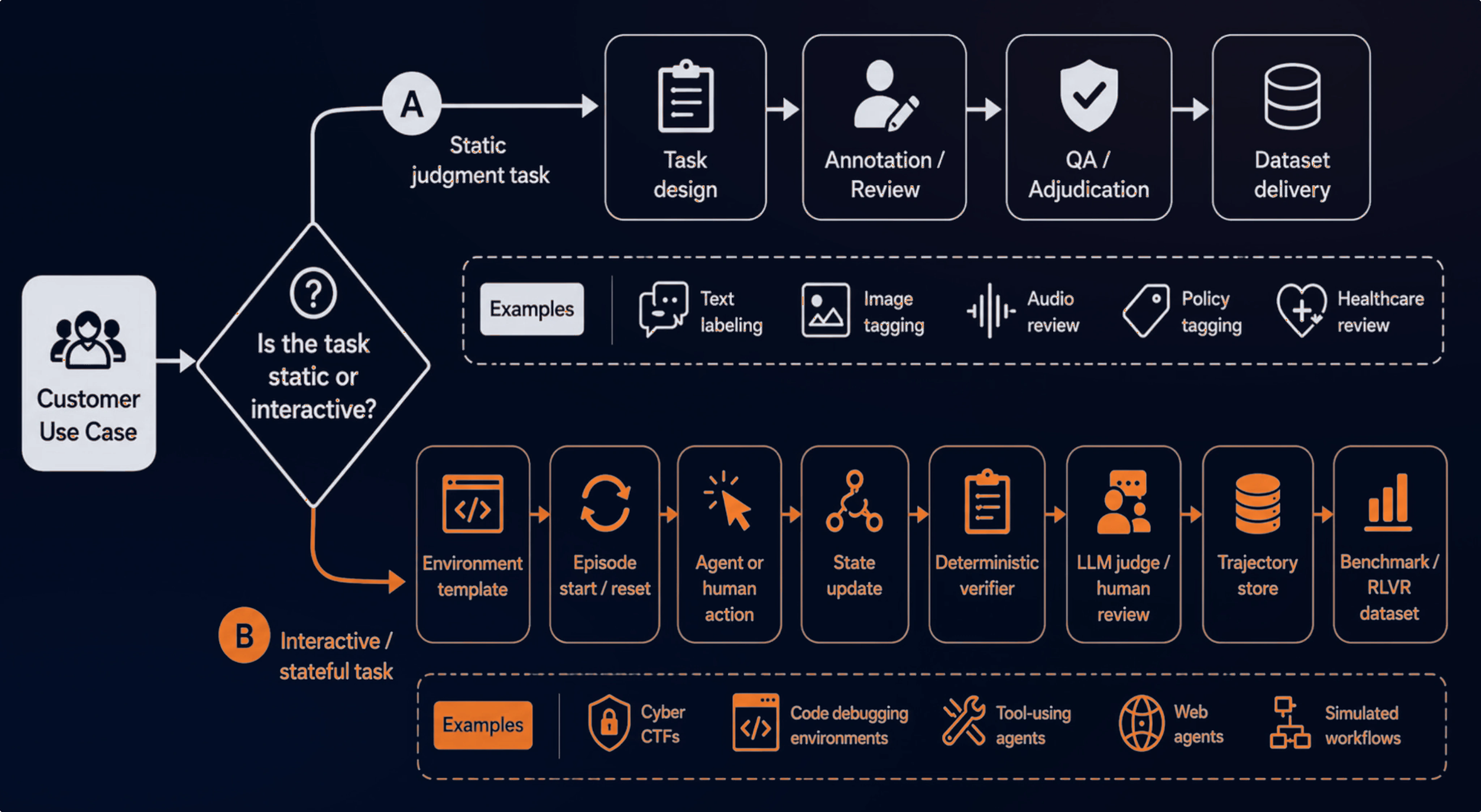
Can quality be judged from a static output, or must it be measured through actions in a live, stateful environment?

For evaluation, labeling, response review, model safety, search quality, and domain expert assessment where quality can be determined from a defined output.
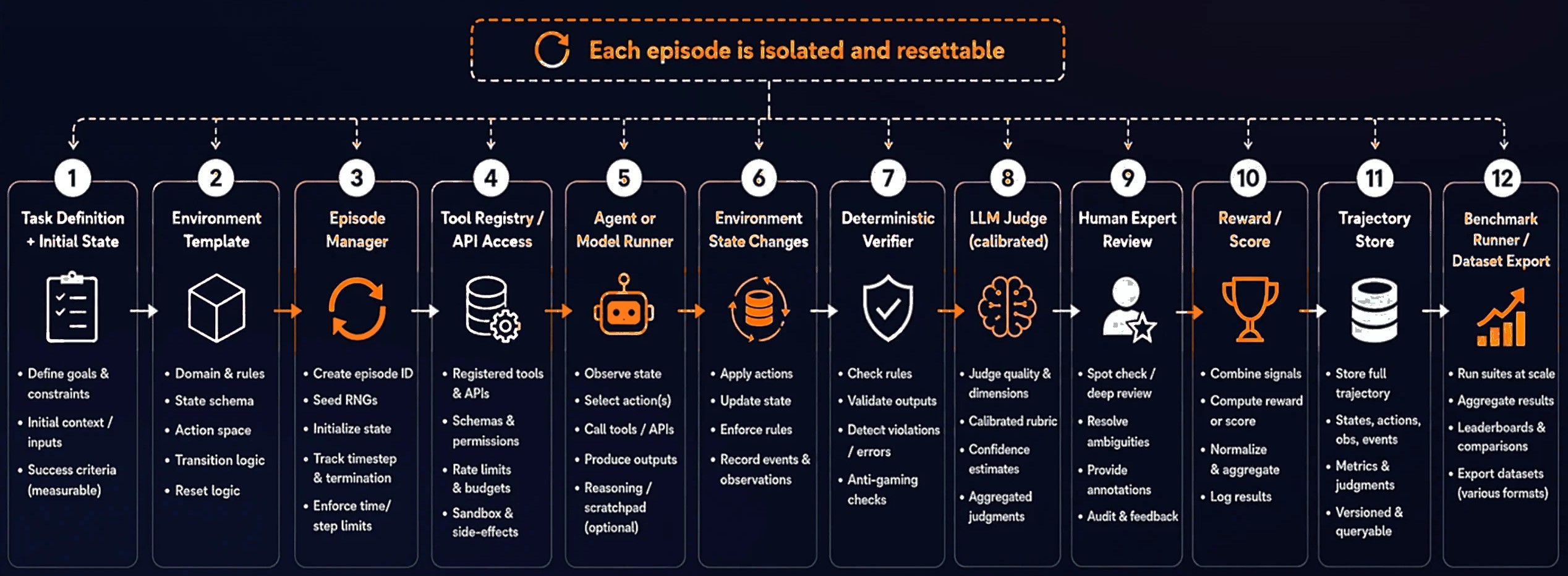
For agents that must take actions in software, modify state, use tools, recover from mistakes, and be scored on actual outcomes instead of offline labels.

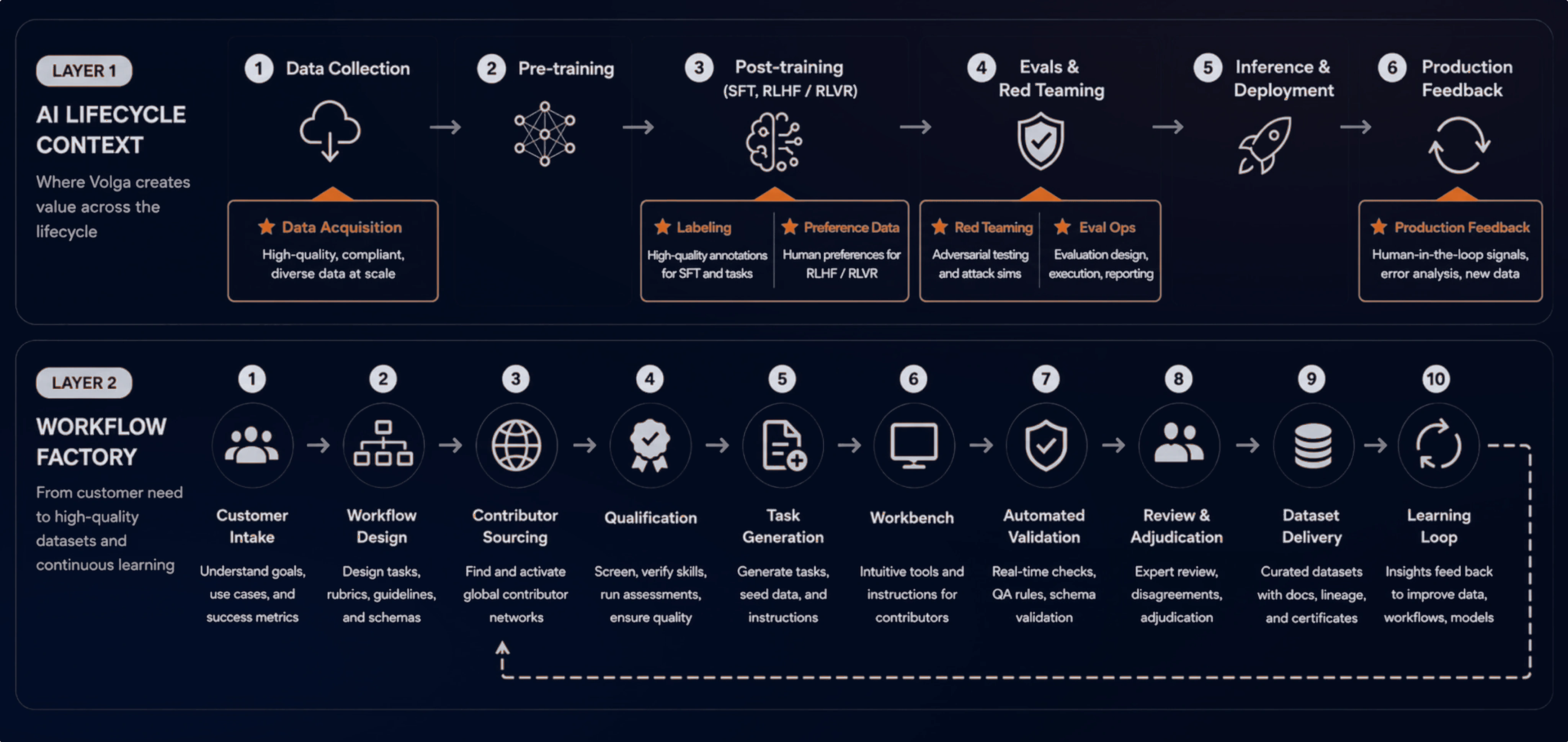
Seven stages connecting data strategy, pretraining, post training, red teaming, deployment, and production feedback.

The production layer that handles customer intake, sourcing, qualification, task generation, automation, review, and learning loops.

Task definition, environment template, episode manager, agent and model runs, state changes, deterministic verification, human review, reward scoring, trajectory storage, and benchmark export.
Incorrect numerical values fail regardless of how fluent the wording appears.
Multiple models compare results so no single model becomes a silent point of failure.
Reviewers approve, edit, or reject every suggestion before anything ships.
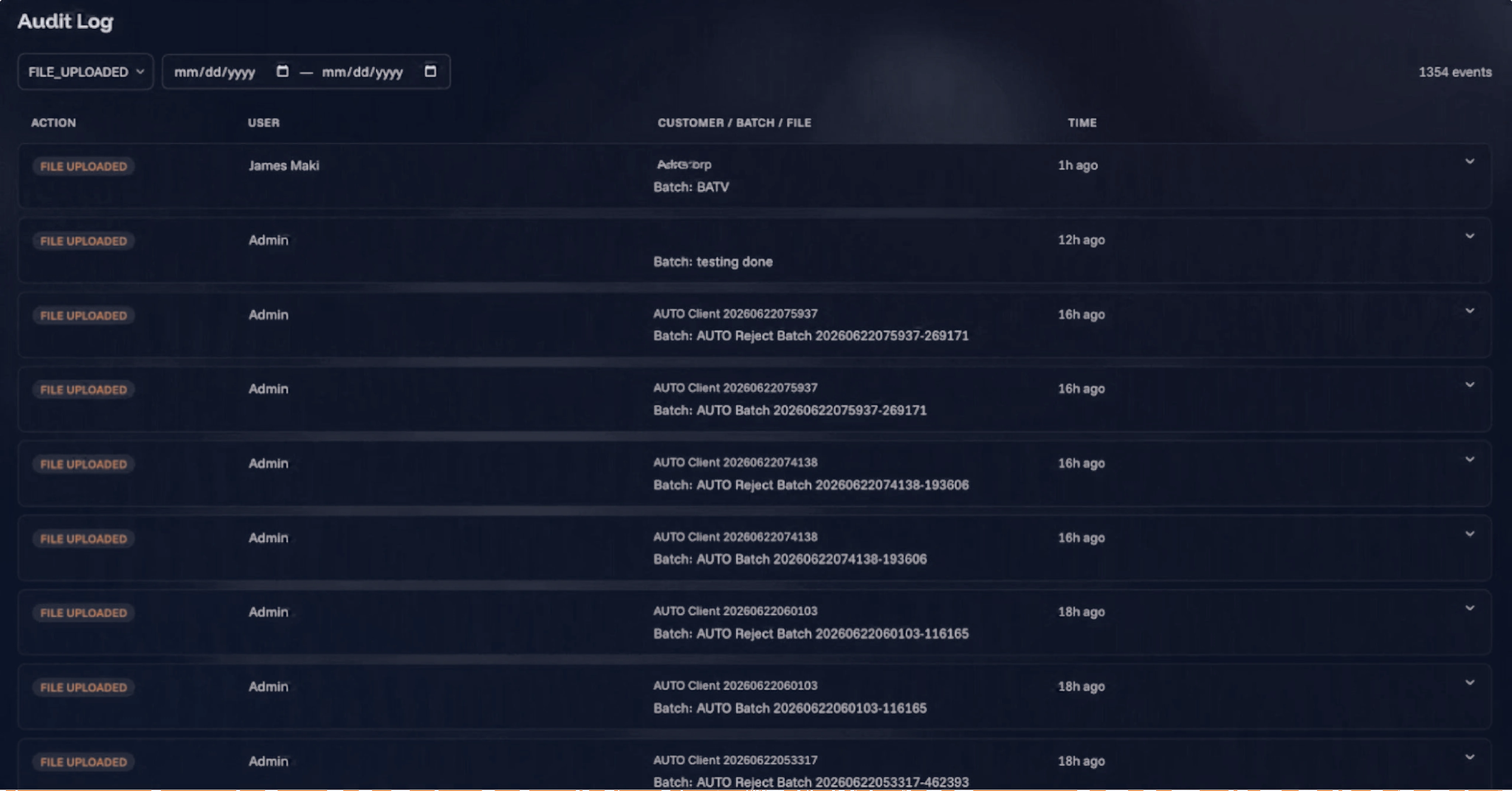
Actions, models, scores, suggestions, users, and timestamps are logged.

A controlled pipeline that combines data, model processing, expert review, scalable judging, structural validation, and deliberate stress testing.
High-quality real and synthetic data that enables LLMs to generate accurate and reliable outputs.
Clear instructions that define the task, expected behavior, and correct execution criteria.
Data and prompts run through the model to produce initial outputs or classifications.
Expert reviewers assess outputs, correct errors, and enforce the defined quality standard.
Independent models review and compare outputs to identify consistency and disagreement.
Raw outputs become structured data and are verified against rules and performance benchmarks.
Complex and edge-case scenarios expose weaknesses, strengthen robustness, and test real-world performance.
Search result optimization, spam detection, intent extraction, structured parsing, and human validation.
Speech data collection, ASR, diarization, evidence analysis, transcription orchestration, and quality review.
Image collection, extraction, visual prompt creation, object and scene analysis, and reviewer validation.
Timestamped ingestion, frame-by-frame processing, temporal consistency, action detection, and anomaly analysis.
High-quality datasets across widely spoken and harder-to-source languages.
Culturally contextual prompts that trigger and test language-specific model behaviors.
Auditors capture slang, idioms, dialect, and cultural meaning that automated systems miss.
Intent, sentiment, safety, and policy validation across linguistic and cultural frameworks.
Medical validation, diagnostic reasoning, terminology, and compliance.
Market synthesis, banking, quantitative reasoning, and sentiment.
Logic evaluation, scientific computation, and technical accuracy.
Learning paths, assessment, and curriculum validation.
Style classification, creative generation, and multimedia review.
Audit, tax, contracts, and regulatory identification.
Deterministic verifiers, strict numerical gates, calibrated model juries, and human approval before delivery.
CPAs, JDs, MDs, CFAs, engineers, linguists, and domain professionals selected through structured qualification.
Tool-agnostic delivery within client infrastructure and proprietary tooling under enterprise security review.
Fast mobilization, layered quality control, transparent reporting, and calibration that maintains quality thresholds as volume grows.
Intelligent content creation, complex data analysis, predictive formula generation, document tooling, and specialized Finance and STEM review.
Search relevance across 150+ languages, shopping intent classification, personalized recommendations, query understanding, product comparison, and spam resistance.
Human evaluation of audio, video, images, text, and AI-generated content for diversity, coherence, motion, relevance, safety, and harmful content classification.
Query and URL relevance, ranking quality, result usefulness, model-generated intent validation, language alignment, cultural context, and real search behavior.
The data quality layer for relevance, spam detection, search result comparison, satisfaction assessment, structured annotation, and cross-project calibration.
Menu validation, multilingual review summarization, sentiment, PII redaction verification, recommendation models, personalization, and marketplace content quality.
RLHF, adversarial prompt generation, red teaming, hallucination detection, robustness testing, grounding validation, safety datasets, policy tagging, and harmful content classification.
Documents processed and used for training across enterprise AI programs.
Processed at 95% final transcription accuracy with 50+ languages onboarded in eight weeks.
Insight extraction improvement in e-commerce review summarization across 2,000+ products.
Multilingual search relevance performance against a 90% client threshold.
250 Korean and Hebrew audio review tasks launched over a weekend and delivered at scale.
Code-switching transcription across 40+ language pairs with word-level language labels.
Whether you are building a new dataset, evaluating a model, launching an agent in a live workflow, expanding into new markets, or running an ongoing AI operation, Volga brings the people, process, platform, and proof.
Talk to our team